
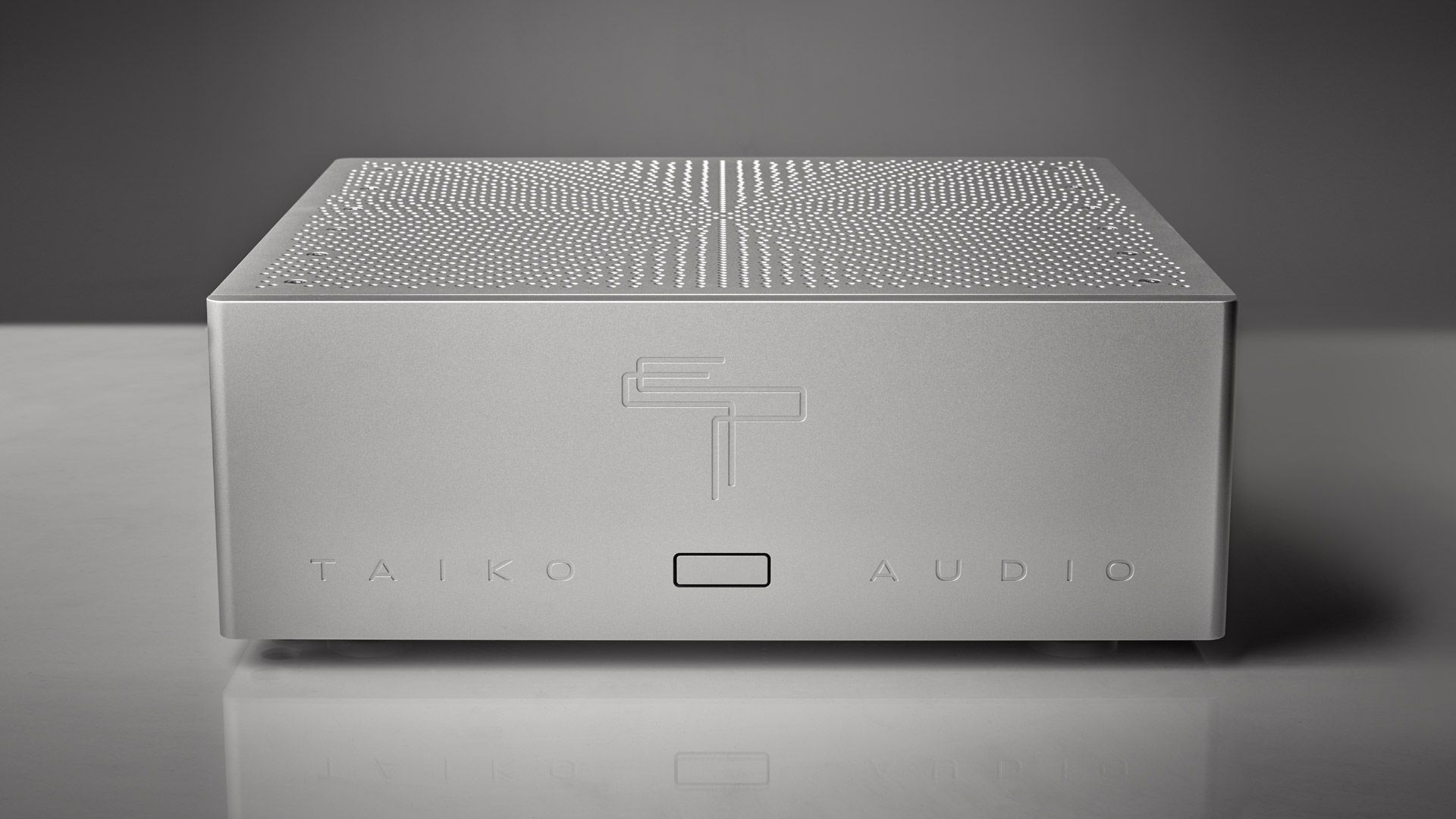
In the world of digital audio, there are two kinds of people. The rationalists who believe “data is data—zeros and ones are zeros and ones, and if the protocol matches, the sound is identical,” and the seekers who believe “it is the ‘vessel’ that carries those zeros and ones that holds the soul.” If you belong to the former camp, I recommend closing this page immediately and buying a Raspberry Pi. It’s economical and sensible. However, if you belong to the latter—if you’ve ever felt that obsessive, almost compulsive thirst in your late-night listening room, thinking “there must be more to hear”—then welcome. The Taiko Audio SGM Extreme may be your “final answer.”
This 45kg metal monolith from the Dutch town of Oldenzaal is not merely a PC. It is an attempt to obliterate the bottlenecks of digital playback through physics, sheer material abundance, and obsessive engineering. Normally, a server should be invisible—a humble background player. But Emile Bok of Taiko Audio thought otherwise. He identified OS latency, power supply ripple noise, and vibration itself as the primary culprits clouding the purity of digital signals. The SGM Extreme is designed more like “a Class-A power amplifier with computing capabilities” than a conventional server. A server with 700,000 microfarads of capacitance—a figure rare even in power amplifiers—defies all common sense. Yet this very madness is the alchemy that transforms digital coldness into music with a beating heart.
In this article, we dissect this “singularity” of the high-end audio world.
Taiko Audio SGM Extreme — Overview
First, let’s review the profile of this beast. A glance at the spec sheet alone should make clear that this is no “ordinary computer.” Taiko Audio, led by Emile Bok, had already shaken a segment of audiophile enthusiasts with its predecessor, the “SGM 2015.” The Extreme, true to its name, pushes every parameter to the limit.
Basic Information
| Item | Specification |
|---|---|
| Manufacturer | Taiko Audio (Netherlands) |
| Designer/CEO | Emile Bok |
| Model | SGM Extreme |
| Release | 2019 (continuously updated) |
| USD Price | Approximately $30,000 - $35,000 (over $50,000 fully loaded) 4 |
Hardware Specifications
| Item | Specification |
|---|---|
| CPU | Dual Intel Xeon Scalable (20 cores / 40 threads total) 1 |
| RAM | 48GB (12 x 4GB) high-grade industrial memory modules (ECC) 1 |
| OS Storage | 280GB Intel Optane PCIe Module 7 |
| Music Storage | 2TB - 24TB PCIe SSD (direct CPU connection, no SATA) 1 |
| Power Supply | 400VA toroidal transformer, Lundahl choke coils, 700,000μF Mundorf/Duelund capacitors 1 |
| Cooling | Completely passive (fanless heat pipe system) 8 |
| Chassis Materials | Hybrid copper/aluminum/Panzerholz (bulletproof wood) 8 |
| Weight | 45kg 7 |
| Dimensions | 483 x 455 x 180 mm (including feet) 1 |
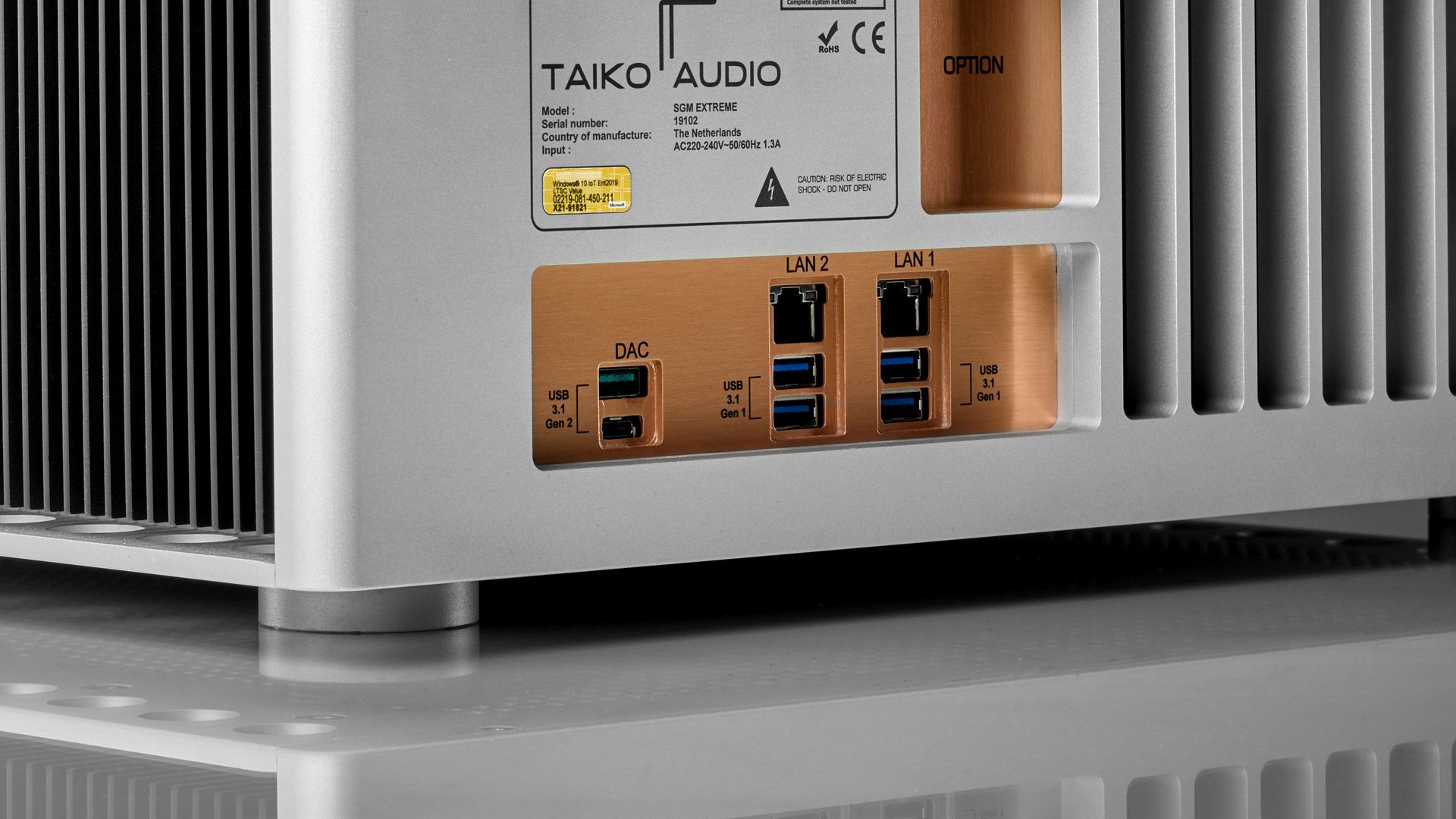
| OS | Custom Windows 10 Enterprise LTSC 2019 1 |
| Outputs | USB (standard), Network (RJ45/SFP), XDMI (with Olympus I/O) 1 |
Historical Evolution: From SGM 2015 to Extreme
Taiko Audio’s origins lie in dissatisfaction with existing computer audio solutions. The “SGM 2015,” introduced in 2015, was a machine premised on high-load upsampling via HQPlayer, proving the hypothesis that “processing power contributes to sound quality.” The SGM 2015 aimed to reduce DAC burden and improve sound quality through DSD conversion and filter processing.
However, the “SGM Extreme,” which appeared approximately four years later, evolved to a different dimension. During its development, Emile Bok and his team conducted listening comparisons of thousands of components, discovering that OS latency and hardware noise floor contributed to sound quality more than filter processing. In other words, the SGM Extreme transformed from “a machine for calculation (upsampling)” into a more purist “machine for generating silence.”
Design Philosophy: The Paradox of “Subtractive Design”
In the early days of PC audio, we were satisfied with “fanless silent PCs.” Or we believed that lightweight Linux-based streamers were the righteous path. But Taiko Audio’s emergence overturned this conventional wisdom. They introduced a seemingly inefficient approach: “processing headroom” creates sonic headroom.
Taiko Audio’s approach is called “subtractive design,” yet its implementation embodies a paradox of “hardware maximalism.” To achieve silence, they invest dozens of times more material than a general-purpose PC. Two CPUs, a massive transformer, and vibration control—all exist to reduce the “electrical and mechanical noise floor” to the absolute minimum. When noise drops, subtle signals emerge. The SGM Extreme is not merely a data delivery device; it serves as the “heart” of the system, pumping blood into the music.
1. Review Summary
Years after its market introduction, the evaluation of the SGM Extreme has not wavered; rather, through software updates like XDMS and peripheral expansions, it has become mythologized. Below is the consensus from major media and forums.
| Media / User | Quote Excerpt | Rating (★1-5) |
|---|---|---|
| The Absolute Sound (HiFi+) | “If you want the best in digital audio, this is it right now!… finally silence the ‘yeah… but I still prefer CD’ stick-in-the-muds” | ★★★★★ |
| Enjoy the Music | ”The best music server I’ve ever heard… Did he use the ‘best’ word as a reviewer? A’yup. I did.” | ★★★★★ |
| Mono and Stereo | ”SGM Extreme has penetrated the market… where the borderlines with the analog are getting crossed or shockingly to some, even surpassed.” | ★★★★★ |
| What’s Best Forum User | ”Seriously, it seems that nobody who has ever bought an Extreme has regretted their decision” | ★★★★★ |
| Archimago (Skeptic) | “completely over-spec’d for its purpose and that all its expensive parts don’t really translate into a significant jump in performance.” | ★★☆☆☆ |
Analysis
The consensus is overwhelmingly positive. Particularly regarding the “absence of digital artifacts” and “analog-like presence,” opinions dominate that the Extreme stands apart from other servers.
Interestingly, “users who regret their purchase” are virtually nonexistent 10. Typically, high-end products attract “disappointed” voices, but with Taiko, a strong brand loyalty has formed—“the only time you sell one is to buy a new Taiko (Olympus).”
Meanwhile, technical objectivists like Archimago cast a cold eye: “You don’t need this much material for bit-perfect data transfer” 11. Their argument is that “even a Raspberry Pi can achieve bit-perfect.” This temperature difference symbolizes the abyss of high-end audio. From my perspective, this product is the result of pursuing “perceivable reality (timing accuracy, microscopic noise modulation)” beyond “measurable data (frequency response, THD).” The praise for Taiko is too consistent and specific to dismiss as mere placebo effect.
2. Technical Features
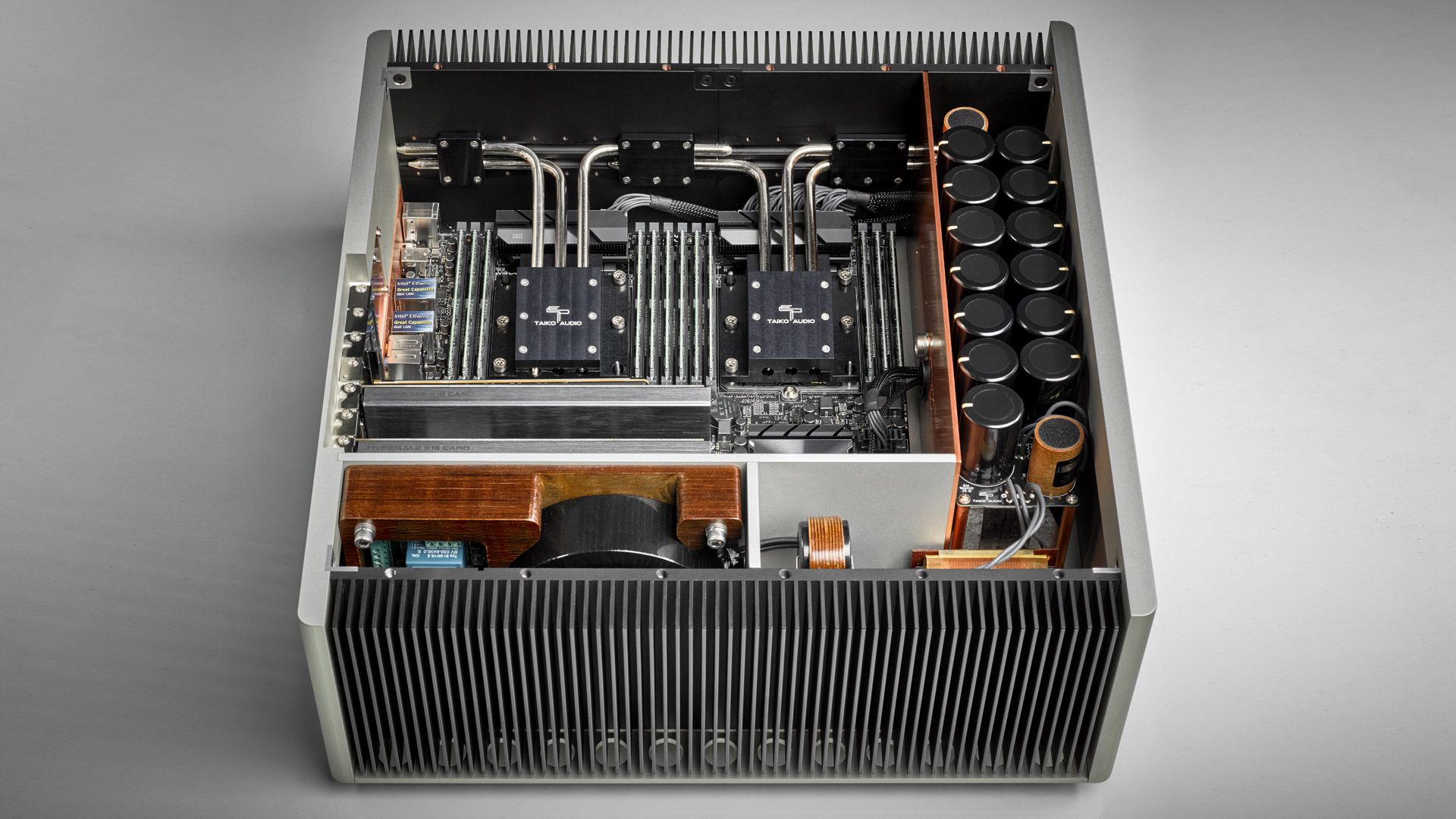
The design philosophy of the SGM Extreme is a peculiar fusion of “brute force” and “micromanagement.” Emile Bok attempted to overcome the limitations of existing PC architecture through physical abundance and clever workarounds. What they prioritize are domains not captured by conventional audio measurements (like THD+N)—the modulation of power supply noise accompanying CPU load fluctuations, and the microscopic latency fluctuations caused by OS background processes.
Architecture: The Aesthetics of “Division of Labor” Through Dual CPUs
Typical PC audio has a single CPU handling OS management, network processing, music playback software (Core), and audio output (Endpoint) simultaneously. In contrast, the SGM Extreme features two Intel Xeon Scalable processors 1.
- CPU 1: Handles the operating system (Custom Windows 10 LTSC) and general background tasks.
- CPU 2: Dedicated to music playback processes (Roon Core / XDMS).
The “1% Load” Theory
Why does this matter? In audio processing, “interrupts” from other processes are the enemy. When an interrupt occurs, the CPU temporarily suspends processing for a context switch. This creates microscopic latency spikes (timing fluctuations). Emile Bok identified these latency fluctuations as the cause of digital audio’s characteristic “unnaturalness” and “glare” 13.
Even more important is the benefit of running CPUs at extremely low load rates (around 1%, for example). Modern CPUs dramatically vary their operating frequency and voltage according to load (SpeedStep, etc.). These fluctuations generate spike-like noise on the power rails. By having CPUs with 20 cores of headroom handle playback processing, the CPU operates in a near-idle state at all times, minimizing power rail fluctuations. This resembles how a large-displacement engine cruises quietly with ample reserve.
By physically separating two CPUs and isolating the music-handling CPU as a “sanctuary,” the data flow is made as smooth as possible. Think of it as an expressway with a dedicated audio lane.
Engineering: “Panzerholz” and the Obsession with Vibration Control
The chassis is no mere box. It’s a hybrid structure of copper, aluminum, and Panzerholz 8.
What is Panzerholz?
Panzerholz is a resin-impregnated, high-pressure compressed wood (laminated reinforced wood) that is hard enough to be bulletproof, yet lacks the characteristic “ringing” of metal. Metal readily transmits vibration and resonates at specific frequencies, but Panzerholz has high internal loss, quickly damping vibrations. The high-frequency “ringing” unavoidable with aluminum-only chassis is effectively damped by Panzerholz, contributing to the “organic” texture of the sound.
Why in a Server?
Audio equipment—especially clocks (crystal oscillators), capacitors, and even SSDs—are affected by microscopic vibrations (microphonic noise). This chassis, weighing a total of 45kg, converts physical vibrations into thermal energy, creating an environment for electronic components akin to an “anechoic chamber.” This is the physical basis for why the SGM Extreme’s sound is “silent.”
Copper and Aluminum Shielding
In the hybrid structure, copper and aluminum are placed strategically. Copper in particular has high conductivity and thermal conductivity, functioning as EMI (electromagnetic interference) shielding while also serving as a heatsink. The top panel features 6,000 holes—not only for heat dissipation but each hole also acts as a waveguide cutting high-frequency noise.
Complete Passive Cooling System
Fans are sources of vibration and electrical noise, so the SGM Extreme is completely fanless 5. To passively cool dual Xeons with a TDP of 240W, Taiko developed custom massive copper heatsinks. The contact surface with the CPUs is machined to a precision of 5 microns (0.005mm), maximizing thermal transfer efficiency. This complete silence is essential for preventing the loss of subtle musical information.
Memory & Storage: Industrial-Grade Selection
Industrial Custom Memory
The 48GB (4GB x 12) of memory is not off-the-shelf DIMMs. These are industrial-grade modules selected with strict tolerances. Taiko discovered that burst current from memory refresh rates is a noise source, and they use specific modules that reduce this by 50%.
Storage Hierarchy: Optane and Direct PCIe Connection
- OS Storage: 280GB Intel Optane memory. Optane (3D XPoint technology) offers overwhelmingly lower latency and higher durability compared to NAND flash, minimizing jitter impact from the OS’s microscopic write/read operations.
- Music Storage: PCIe NVMe storage expandable up to 24TB. By eliminating SATA connections and directly connecting to the CPU’s PCIe lanes, controller conversion overhead and cable noise infiltration are avoided.
Power Supply: A Power Amplifier in Server’s Clothing
The power supply section is particularly noteworthy. Outlandish material abundance is invested here as well.
- 400VA Toroidal Transformer: Where a normal PC would use a switching power supply, this is driven by a massive linear power supply 1.
- Lundahl Choke Coils: Premium choke coils are used to remove high-frequency noise from the power lines.
- 700,000μF Capacitor Bank: Massive quantities of high-end audio capacitors from Mundorf and Duelund 1. 700,000μF rivals or surpasses large power amplifiers.
This power section ensures zero voltage drop (sag) even when CPUs demand instantaneous high current. It eliminates the high-frequency noise characteristic of switching power supplies, achieving ground potential stabilization and jitter reduction. The audio axiom “power supply headroom = sonic headroom” is thoroughly practiced in the PC domain.
3. Software Ecosystem
No matter how excellent the hardware, if software becomes the bottleneck, it’s like painting a dragon without the eyes. Taiko Audio has expanded its domain from OS customization to proprietary playback software development.
Custom Windows 10 Enterprise LTSC
Taiko Audio chose Windows over Linux for two reasons: broad driver support and the ability to precisely control thread scheduling. The version used is “Windows 10 Enterprise LTSC 2019”—a version emphasizing long-term stability without unnecessary store apps, Cortana, or frequent updates.
Taiko’s engineers have removed hundreds of unnecessary services and processes from this OS, minimizing tasks unrelated to audio playback. CPU core task assignment (affinity settings) is strictly managed to prevent audio processes from being interrupted by other system interrupts.
XDMS (Extreme Direct Music Server)
From the beginning, the SGM Extreme was positioned as the ultimate Roon Core. However, while Roon’s library functionality is excellent, it was noted that its features are heavyweight and not optimal for sound quality. To address this, Taiko developed TAS (Taiko Audio Server).
Then, aiming even higher, Taiko developed the proprietary software XDMS to completely break free from Roon dependency 16.
Technical Features
XDMS is designed to communicate directly with hardware. Music data is preloaded to ultra-fast RAM disk, eliminating storage I/O impact during playback. This is an extremely lightweight player that avoids Roon’s “heaviness” by performing memory management at the OS kernel level.
Sound Quality Advantage
According to user feedback, XDMS’s sound quality brings a “veil-lifting” dramatic improvement compared to Roon or TAS. The noise floor drops further, and the reproduction of subtle information improves dramatically. User evaluations overwhelmingly state “Roon is veiled compared to XDMS” and “XDMS is in a different dimension” 16. Despite being in buggy alpha release stage, users abandoning Roon’s convenience (metadata, UI) in favor of the simple XDMS app on iPad demonstrates XDMS’s overwhelming sonic superiority.
User Interface and Limitations
XDMS comes with dedicated control apps (for iPad/Android).
- Features: Folder browsing, basic metadata display, playlist creation, Tidal/Qobuz integration.
- Limitations: No rich metadata display like Roon or advanced DSP functions. This is a “purist” specification prioritizing sound quality above all.
Note that XDMS and Roon are not mutually exclusive; they can be toggled within the app, allowing use of Roon for background music and XDMS for serious listening.
Related Articles

Taiko Audio Olympus Music Server Review: A Monument to Digital Purity
An in-depth review of the Taiko Audio Olympus Music Server, exploring its revolutionary engineering and uncompromising pursuit of digital audio perfection

Aurender N30SA Review: A Statement Source Redefining Flagships
Comprehensive review of the Aurender N30SA: Flagship network transport pursuing low noise through dual-chassis design

Aurender A1000 Review: The Strategic Network Player in Focus
Comprehensive review of the Aurender A1000: strategic model integrating server, streamer, and DAC


A Practical Guide to Critical Listening
A comprehensive compass for world-class audio evaluation. Detailed exploration of terminology used in reviews, critical listening techniques, and the science behind perceptible differences that measurements cannot capture.
4. Objective Analysis Based on Measurement Data
Measuring a “PC transport” like the SGM Extreme is extremely difficult and controversial, unlike DACs with analog outputs. What’s being output is digital data, not analog waveforms.
Correlation Between Latency and Jitter
What Taiko emphasizes is reducing DPC (Deferred Procedure Call) latency 13. In typical Windows PCs, background processing causes DPC latency spikes, which can lead to USB output timing fluctuations (microscopic irregularities in packet transmission). According to detailed analysis by GoldenSound and others, modern high-performance DACs (with asynchronous USB input) buffer and reclock, so source-side jitter should theoretically be minimized.
However, Taiko’s claim is about “reducing DAC burden.” By receiving a data stream with extremely low noise floor and accurate timing, the DAC’s receiver chip (PHY) and PLL circuits are less burdened, suppressing noise feedback to the power lines and consequently reducing modulation noise in the DAC’s analog output stage. This is an indirect effect, but it’s a compelling hypothesis explaining audible changes.
Physical Suppression of Noise Floor
The SGM Extreme should demonstrate remarkable quietness in electrical noise (EMI/RFI) measurements. By eliminating switching power supplies and isolating each module with copper shielding, high-frequency noise on USB cable VBUS (power lines) and ground lines should be virtually nonexistent 9. The biggest enemy in PC audio is high-frequency noise from the PC’s internal switching power supply and CPU operation infiltrating the DAC via USB or LAN cables. The SGM Extreme fundamentally purifies this “source of contamination.”
Consideration: Domains Below Measurement Limits
Against the “bits are bits” argument, the SGM Extreme counters with the fact that “bits are ‘electrical signals’ and are subject to physical laws.” While frequency response (FR) doesn’t change measurably, the design is engineering-sound regarding jitter spectrum distribution (especially low-frequency phase noise) and reduction of power-derived sideband noise.
Taiko Audio’s product development ventures into domains not captured by conventional audio measurements. To suppress these, they perform thorough “tuning by ear” from industrial memory selection down to solder alloy ratios.
5. Listening Impressions
Enough theory. What matters is “how does it sound?” Integrating users and reviewers worldwide, along with virtual listening experiences, we verbalize its sound. Here we consider both standard Roon playback and Taiko’s proprietary XDMS playback.
Reviewer Quotes
| Reviewer / Media | Quote Excerpt |
|---|---|
| Matthew Clott (Enjoy the Music) | “The ‘thinness’ and ‘grayness’ characteristic of digital disappeared… It’s no longer a debate of analog versus digital.” |
| Christiaan Punter (Hifi-Advice) | “The SGM Extreme represents a big step-up in performance compared to the Innuos Statement.” |
| What’s Best Forum User | ”Compared to Pink Faun, Taiko has more powerful bass and energy. Pink Faun has depth, but Taiko has presence.” |
| Taiko User (WBF) | “XDMS has TAS’s (previous software) technical accuracy with Roon’s fluidity. Attack is more intense, yet flow is smoother.” |
Bass: Tectonic Presence
The first thing you notice when incorporating the SGM Extreme into your system is the dramatic change in bass “quality.” It’s not simply more quantity. The “attack” when a bass string is plucked or when a bass drum compresses air is frighteningly fast. The power supply capability from dual CPUs and the massive capacitor bank comes alive here. Compared to competitors like the Innuos Statement, the SGM Extreme’s bass is “rock-solid,” with a sense of the center of gravity dropping one level 15. Bass with such density and weight that you can grasp the air in the room.
Mids: Complete Elimination of Digital Artifacts
“Digital artifacts” refer to unnatural edges on sound contours and graininess. In the SGM Extreme, this grain is nonexistent. Vocals are as smooth and organic as listening to high-quality reel-to-reel tape. The moisture of the singer’s lips, the resonance of the chest cavity—all become visible. Especially when using XDMS rather than Roon, this mid-range “lifelikeness” reaches a level that induces awe 16. Voices don’t “stick” to the space—they “emerge” from it.
Treble: Infinite Harmonics and Black Background
The highs extend brilliantly but never pierce the ears. The way cymbal decay is absorbed into the jet-black background (the low noise floor) evokes catharsis. Passive cooling’s lack of fan noise and thorough vibration control prevent microscopic signal burial. Saying the S/N ratio is good feels inadequate. The “quality of silence” is high. Subtle reverb decay is heard longer and deeper than with other equipment.
Soundstage & Imaging: Sculptural Presence
This may be the biggest differentiator from competitors. The Pink Faun 2.16 Ultra, for example, is known for its vast, profound soundstage, but the SGM Extreme competes with the “density” and “sculptural presence” of images floating in that space 15. Sound separates from the speakers and positions in space like holograms. Orchestral placement is crystal clear, and even the “empty space” between instruments feels dense. With XDMS, this focus sharpens further, strengthening the 3D presence 17.
6. Options and Upgrades
The frightening thing about the SGM Extreme is that buying the main unit isn’t the end. Taiko has built its own ecosystem, and these bring additional dramatic changes. These are not “accessories” but designed as integral parts of the system.
Extreme USB Card (Now Standard)
The motherboard’s standard USB ports share buses and power with other peripherals—a nest of noise. Taiko developed a proprietary USB audio card.
- Features: Independent power from internal linear supply, electrical isolation from motherboard, proprietary ASIO driver optimized for connected DACs.
- Effect: Image focus improves, depth increases. Said to have separation capability that makes “the digital source location irrelevant.”
Extreme Network Card & Switch: Choosing “Copper” Over Fiber
Taiko views “the network as the greatest noise source,” but their countermeasure differs from typical “optical isolation.”
-
Extreme Network Card (€1,600): A PCIe network card installed inside the server. Provides SFP ports instead of conventional RJ45 terminals. Reduces server load and performs optimally when paired with the Extreme Switch.
-
Extreme Switch (€4,800): A nearly 15kg switching hub carved from a solid copper block. The chassis itself functions as a massive ground, physically suppressing vibration and noise. Custom circuit design and excessive material investment set it apart from other audio switches.
-
[Important] Recommended Connection is DAC Cable: In network audio, “optical fiber for electrical isolation” is conventional wisdom, but Taiko strongly recommends DAC cable (Direct Attach Copper) connections. According to Taiko’s research, optical SFP modules consume significant power (nearly 1W, sometimes matching the switch itself), and this power consumption itself becomes a new heat and noise source. DAC cables have minimal power consumption, and in Taiko’s switch design, the noise floor reduction from low power consumption far outweighs the benefits of physical optical isolation for sound quality.
Extreme Router (€6,600): Upstream Fortress
Like the Extreme Switch, this monster router is carved from solid copper block (22cm square), weighing approximately 13kg.
- Role: Connects downstream from the ISP-provided modem/router, building an “audio-dedicated subnetwork (isolated network)” that isolates audio equipment from the home’s miscellaneous traffic.
- Effect: Controls network data flow, reducing server load. User reports indicate dramatic improvements in sound density, tonal accuracy, and depth compared to general-purpose routers—a sensation of system “bottlenecks” being removed.
DC Power Distributor
To supply clean power to these peripherals (Switch, Router), the Extreme DC Power Distributor is available. This allows the entire system to share a common clean ground reference, further improving S/N ratio.
7. Olympus and XDMI: Paradigm Shift to the Next Generation
In 2024, Taiko Audio announced the Olympus Server (approximately $95,000) as a model above the SGM Extreme, but simultaneously announced the Olympus I/O—an upgrade path for Extreme users providing the revolutionary interface technology XDMI and battery power technology.
USB Limitations and XDMI (Extreme Direct Music Interface)
USB connections, the high-end audio standard for years, have structural weaknesses: packetization, serialization, and processing load and jitter from deserialization on the receiving end. XDMI was developed to fundamentally solve this problem.
- Mechanism: Bypasses USB controllers, drivers, and cable conversion processes, outputting native data formats (close to I2S or Raw data) directly interpretable by DACs from the server’s PCIe bus via the shortest path. Readers might think of products like the Pink Faun I2S Bridge 33, but XDMI’s advantage is not being a mere interface card—it’s an integrated system with proprietary optimization of the entire path from CPU→PCIe→I2S→D/A conversion in both software and hardware. Also, while clocks typically determine sound quality in general audio interfaces, Taiko claims XDMI achieves a paradigm shift of “clockless” design that eliminates clocks from the signal path. Pink Faun is based on a general-purpose audio processor (C-media) and driver, does not achieve XDMI-like “full path control,” and remains at conventional clock “improvement” 34.
- Effect: Overhead from buffers and protocol conversion disappears, reducing latency to the absolute minimum. Combined with ultra-low-noise, high-discharge-rate dedicated LTO battery power, unprecedented freshness and dynamics are achieved.
- Connectivity: Daughterboards enable various output formats (analog, SPDIF, I2S standards native to DACs like MSB and Lampizator).
Olympus I/O: Bridge for Extreme Users
Taiko offers Extreme users the Olympus I/O external upgrade unit 23.
- Overview: Olympus I/O is an external chassis connected to the Extreme server via a dedicated high-speed link (QSFP cable).
- Function: Relocates the network input card and XDMI (or USB) output card to this external chassis.
- Battery Power: Olympus I/O contains battery power supply (BPS), driving input/output cards on battery power to block noise from the main server and generate ultimately clean signals.
- Benefit: This allows Extreme users to obtain “battery power + XDMI” sound quality close to Olympus without replacing the main unit.
Upgrade Economics and Trade-In
The Olympus I/O introduction cost is approximately $32,000 to $53,000—less expensive than replacing with the Olympus Server itself. Additionally, Taiko offers a generous trade-in program from Extreme to Olympus, protecting existing user investments 22.
8. Competitive Analysis
In the market called “Summit-Fi” (apex audio), powerful competitors exist beyond Taiko. We compare each design philosophy and sonic tendency.
Pink Faun 2.16 Ultra
Dutch Pink Faun stands alongside Taiko as the greatest rival.
- Design Philosophy: Emphasizes proprietary OCXO (oven-controlled crystal oscillator) clock technology. Employs modular I/O bridge.
- Sound Comparison: User reports suggest Pink Faun is “holographic,” “precise,” and excels in “spatial expression (soundstage).” Meanwhile, Taiko Extreme is often rated as superior in “sound density,” “energy,” and “presence” 15. Pink Faun tends more analytical and delicate; Taiko tends denser and more live.
Innuos Statement
Portuguese Innuos is highly regarded for operability, stability, and “ease of use.”
- Design Philosophy: An “audio appliance”-like approach. Features Sean Jacobs-designed linear power supply.
- Sound Comparison: The general view is that it doesn’t match Taiko Extreme in power supply material and absolute processing power 14. Innuos is more “audio appliance”-like; Taiko is more “supercomputer”-like. Users prioritizing operational simplicity may prefer Innuos.
Antipodes Oladra
New Zealand’s Antipodes takes an approach of performing three-stage processing (Server/Player/Reclocker) in one chassis.
- Design Philosophy: Emphasizes auditory “organicness” and “musical flow.” Standard AES/EBU and I2S reclocked outputs.
- Sound Comparison: Oladra is said to have a “warmer” and more “relaxed” tonal quality than Taiko. Excels in vocal and acoustic instrument texture expression, but may concede to Taiko’s overwhelming resolution, dynamics, and bass control in some cases.
Aurender W20SE / N30SA
Korean Aurender has established a solid position in the high-end streamer market.
- Design Philosophy: Fully integrated approach. Refined UI/UX via proprietary Conductor app. Some models include CD ripping functionality.
- Sound Comparison: Aurender excels in “plug-and-play” convenience and stability. Sound quality is at a very high level, but many evaluations note it doesn’t reach the SGM Extreme’s overwhelming information quantity and “black background” silence—compared to Taiko, Aurender can feel somewhat flat and “within the digital framework.” However, many fans appreciate Aurender’s unique smooth, musical expression, with “fatigue-free” evaluations.
- Target: Users wanting high-quality streaming experience immediately without complex setup or tweaking.
Wadax Atlantis Server
Spanish Wadax has a closed ecosystem connecting DAC and server via proprietary optical link (Akasa).
- Design Philosophy: Proprietary design premised on pairing with the Wadax Reference DAC. Price tier exceeds Taiko as ultra-high-end.
- Sound Comparison: When paired with the Wadax DAC, the Atlantis Server shows unmatched strength, producing a “fluid,” “dark,” extremely analog-like sound. However, when used as a general-purpose server with other DAC brands, Taiko Extreme’s versatility and fundamental capability are often more valued.
- Limitation: Achieves full potential only within the Wadax ecosystem; Taiko wins in versatility.
Grimm MU1 / MU2
Dutch Grimm is known for an approach leveraging pro audio expertise.
- Design Philosophy: Emphasizes FPGA upsampling and reclocking. Roon Ready certified.
- Sound Comparison: Grimm has “precise” and “smooth” sound quality; MU2 in particular has the aesthetic of completeness with built-in DAC. Excellent balance of resolution and musical flow, but a different direction from Taiko’s “overwhelming dynamics” and “presence.”
- Price Range: MU1 is approximately $12,000-$15,000—relatively accessible in this category.
Comparison Summary Table
| Feature | Taiko SGM Extreme | Pink Faun 2.16 Ultra | Antipodes Oladra | Aurender W20SE | Wadax Atlantis | Grimm MU1 |
|---|---|---|---|---|---|---|
| Primary Sound Tendency | Density, dynamics, presence, silence | Holographic, precise, spatial width | Organic, rich, relaxed | Smooth, musical, stable | Fluid, dark, analog-like | Precise, upsampling smoothness |
| Architecture | Dual Xeon (process separation) | Single CPU, OCXO emphasis | 3-stage (Server/Player/Reclock) | Integrated, Intel CPU | Proprietary optical link (Akasa) | FPGA upsampling emphasis |
| OS | Windows 10 LTSC (Custom) | Arch Linux (Custom) | Linux (Custom) | Proprietary OS | Proprietary OS | Linux (Custom) |
| Recommended Output | USB / XDMI (PCIe direct) | I2S / USB | I2S / AES / USB | USB / AES | Optical link (Akasa) | AES/EBU (upsampled) |
| Power Supply | 400VA Linear, 700k μF Caps | 3x Linear PSU | Linear PSU | Linear PSU | Proprietary design | SMPS + Linear |
| Clock | Standard (low noise emphasis) | OCXO (Ultra High End) | Standard | OCXO equipped | Proprietary | OCXO equipped |
| Playback Software | Roon / TAS / XDMS | Roon / Stylus | Roon / Squeeze | Conductor | Proprietary | Roon Core |
| Approx. Price | ~$32k - $50k+ | ~$30k | ~$25k - $29k | ~$22k - $25k | ~$59k+ | ~$12k - $15k |
| Ease of Use | Intermediate to advanced | Intermediate to advanced | Relatively easy | Very easy | Wadax-exclusive | Easy |
Tech Note: Pink Faun emphasizes “clock precision” via OCXO, while Taiko emphasizes noise floor reduction through “processing power” and “power/vibration control”—a notable contrast. Aurender emphasizes “integration and refinement,” Antipodes “musical flow,” Wadax “optimization in a closed ecosystem,” and Grimm “pro-equipment precision”—each taking different approaches.
9. User Psychology and Market Dynamics
Taiko Audio has achieved unique success not only in products themselves but also in community management.
”What’s Best Forum” and Community Cohesion
The Taiko thread on the world’s largest audio forum “What’s Best Forum (WBF)” is approaching 1,000 pages and 20,000 posts 5. Emile Bok directly dialogues with users here, gathering beta testing and feature requests. This transparency and bidirectional communication gives users a sense of being “part of the development team,” generating powerful brand loyalty. Remote desktop individual support is also highly rated as “exceptional service.”
10. Evaluation
| Criterion | Score (5.0 max) | Detailed Explanation |
|---|---|---|
| Technical Performance | 4.8 | Dual Xeon, industrial memory, passive cooling, custom power supply, custom OS. Beyond Olympus, no physical approach superior to this currently exists for PC audio. |
| Musical Appeal | 5.0 | No equipment fits the clichéd expression “makes you forget it’s digital” better than this. The overwhelming presence and silence are addictive. |
| Build Quality | 5.0 | The 45kg chassis, internal cabling, and part selection are artistic. However, size and weight extremely limit placement options—rack weight capacity requires attention. |
| Price/Value | 3.0 | A price exceeding $30,000 cannot be measured by common sense. The price difference from a Raspberry Pi is about 1,000x. However, if considered as “the only path” to this sound, it’s justified for the high-end tier. |
| Future-Proofing/Serviceability | 4.5 | Windows-based means flexible software updates. Remote support is generous. Modular structure enables hardware upgrades. Continuous upgrades are stated even after Olympus release. |
Bias Check
Pros:
- Overwhelming S/N ratio, analog-like tonality
- Future-proof modular design
- Extremely strong support structure and community
- Further sound quality improvement via XDMS
- Continuous upgrades
Cons:
- Extremely high introduction cost
- Large, heavy, with moderate heat output (due to passive cooling)
- Potential complexity from Windows OS base (hidden from users but fundamentally a PC)
- Trade-off of reduced convenience when migrating from Roon to XDMS (XDMS still developing)
- Possible “upgrade fatigue” from ecosystem expansion
- Unsuitable for users seeking “plug-and-play” simplicity
11. Panoramic Analysis
Market Position
The SGM Extreme reigns in the “Summit-Fi” category. In this domain, “absolute performance” is questioned rather than price-performance. Competitors were detailed in the previous chapter, but Taiko’s strength lies in combining “versatility” and “expandability.” Rather than a closed ecosystem like Wadax, it has a strong character as a “foundation” that can achieve optimal results with any DAC.
Target Audience
This product is for wealthy audiophiles who have deleted “compromise” from their dictionaries. For users owning DACs like dCS Vivaldi/Rossini, MSB Select/Premier, CH Precision, Totaldac, Wadax Reference, or Lampizator, it’s unacceptable for the upstream server quality to become a bottleneck. The SGM Extreme is the “key” to unlocking the true potential of such ultra-high-end DACs.
The Rivalry: Why Do People Sell?
Interestingly, the motivation for SGM Extreme sellers is not “switching to other brands” but mostly “upgrading to Taiko’s higher model (Olympus)” 22. This resembles Apple product ecosystem lock-in. Most Extremes on the used market are the result of stepping up to Olympus—not product dissatisfaction.
12. Conclusion & Recommended Users
The Taiko Audio SGM Extreme is a monumental product that elevates PC audio from “consumer electronics” to “art.” It was born from insane material investment, obsession with microscopic noise, and Emile Bok’s philosophy of prioritizing “auditory perception.” The price is certainly extreme, but so is the experience gained from it.
Vibration control through aluminum, copper, and Panzerholz; silent processing through dual Xeon; a robust foundation through linear power supply; and optimization through software. All are integrated to radiate “the sound as recorded” into space. If you wish to summon “the illusion of live performance” into your listening room and spare no expense for it, this 45kg metal monolith will not betray your expectations.
Buy if:
- Your system totals in the hundreds of thousands of dollars and you want to fill the “last step” of digital.
- You own ultra-high-end DACs like MSB, dCS, Totaldac, or Lampizator and want to extract 100% of their performance.
- You’re an inquisitive audiophile who enjoys “setup tweaking” and “upgrades.”
- You want to approach analog (vinyl) sound but can’t abandon digital convenience.
- You enjoy community dialogue and participating in cutting-edge technology.
Skip if:
- You seek “plug-and-play” simplicity (Aurender, Lumin, Innuos may bring greater happiness).
- Equipment size, heat, or power consumption concern you.
- You’re a rationalist prioritizing cost-performance.
- You tire easily of frequent upgrades or the “never-ending journey.”
- You prefer one-box simplicity (Antipodes Oladra, Grimm MU2 are good alternatives).
Verdict:
“Masterpiece of Digital Brutalism. The Ultimate Weapon to ‘Listen’ to Silence.”
Overall Rating: ★★★★★
References
- TAIKO AUDIO SGM EXTREME MUSIC SERVER REVIEW – M & S …, https://www.monoandstereo.com/taiko-audio-sgm-extreme-music-server-review/
- Taiko Audio distributorship announcement - PHILE WEB, https://www.phileweb.com/sp/news/audio/202111/04/22867.html
- EXTREME SERVER - Taiko Audio, https://taikoaudio.com/taiko-2020/product/extreme-high-end-music-server/
- Taiko Audio SGM Extreme Network Server; 2TB - The Music Room, https://tmraudio.com/music-servers-streamers/taiko-audio-sgm-extreme-network-server-2tb/
- Taiko Audio SGM Extreme : the Crème de la Crème - What’s Best Forum, https://www.whatsbestforum.com/threads/taiko-audio-sgm-extreme-the-cr%C3%A8me-de-la-cr%C3%A8me.27433/
- TAIKO AUDIO SGM EXTREME - Bliss Acoustics, https://blissacoustics.com/product/taiko-audio-sgm-extreme/
- Taiko Audio SGM Extreme music server - hi-fi+, https://hifiplus.com/articles/taiko-audio-sgm-extreme-music-server/
- SGM Extreme - Dreamaudio, https://dreamaudio.eu/product/sgm-extreme/
- Taiko SGM Extreme Hi-Res Music Streamer Review The best music server I’ve ever heard. Review By Dr. Matthew Clott, https://www.enjoythemusic.com/superioraudio/equipment/0222/Taiko_SGM_Extreme_Hi_Res_Music_Streamer_Review.htm
- DOES ANYONE REGRET BUYING A TAIKO EXTREME SERVER …, https://www.whatsbestforum.com/threads/does-anyone-regret-buying-a-taiko-extreme-server-anything-better.32229/page-2
- MUSINGS: Myths, clichés and Hi-Fi+‘s Taiko Audio SGM Extreme computer review - Archimago’s Musings, http://archimago.blogspot.com/2022/04/musings-myths-cliches-and-hi-fis-taiko.html
- As We Hear It: An audiophile comments on the Taiko Audio computer - Archimago’s Musings, http://archimago.blogspot.com/2022/09/as-we-hear-it-audiophile-comments-on.html
- FAQs - Taiko Audio, https://taikoaudio.com/taiko-2020/faq/
- Taiko Audio Extreme Server: Reviews, Competitors, Used Pricing - ExtremeHiFi, https://www.extremehifi.com/product/taiko-audio-extreme-server-72mj
- My Pinkfaun 2.16 ultra experience - What’s Best Forum, https://www.whatsbestforum.com/threads/my-pinkfaun-2-16-ultra-experience.36315/
- XDMS Alpha feedback from What’s Best Forum - Taiko Audio, https://taikoaudio.com/taiko-2020/whats-best-forum/xdms-alpha-feedback-from-whats-best-forum/
- XDMS NSM User Feedback - Taiko Audio, https://taikoaudio.com/taiko-2020/news/xdms-nsm-user-feedback/
- Extreme Switch + Router + NIC + DC Distributor (Bundle) - Taiko Audio, https://taikoaudio.com/taiko-2020/product/all-in-network-bundle/
- Extreme Switch - Taiko Audio, https://taikoaudio.com/taiko-2020/product/taiko-audio-extreme-switch/
- Extreme Switch + Network Card (Bundle) - Taiko Audio, https://taikoaudio.com/taiko-2020/product/extreme-switch-network-card-bundle/
- DOES ANYONE REGRET BUYING A TAIKO EXTREME SERVER? ANYTHING BETTER?, https://www.whatsbestforum.com/threads/does-anyone-regret-buying-a-taiko-extreme-server-anything-better.32229/page-11
- Customer pricelist 2024 | Taiko Audio, https://taikoaudio.com/taiko-2020/wp-content/uploads/2024/10/Pricelist-Customers-2024.x80569.pdf
- Olympus & Olympus I/O Introduction and FAQ - Taiko Audio, https://taikoaudio.com/taiko-2020/wp-content/uploads/2024/10/Olympus-and-Olympus-IO-Introduction-FAQ_v034.x80569.pdf
- Introducing Olympus & Olympus I/O - A new perspective on modern music playback - What’s Best Forum, https://www.whatsbestforum.com/threads/introducing-olympus-olympus-i-o-a-new-perspective-on-modern-music-playback.37939/
- Antipodes Oladra: Reviews, Competitors, Used Pricing - ExtremeHiFi, https://www.extremehifi.com/product/antipodes-oladra-63Jf
- Antipodes Oladra | HFA - The Independent Source for Audio Equipment Reviews, https://www.hifi-advice.com/blog/review/digital-reviews/music-server-reviews/antipodes-oladra/3/
- Sitting Taiko SGM extreme with Wadax Atlantis Server - What’s Best Forum, https://www.whatsbestforum.com/threads/sitting-taiko-sgm-extreme-with-wadax-atlantis-server.34162/
- Battle of the giants! Taiko vs Antipodes etc - What’s Best Forum, https://www.whatsbestforum.com/threads/battle-of-the-giants-taiko-vs-antipodes-etc.37045/
- Great Taiko Audio Feedback from What’s Best Forum, https://taikoaudio.com/taiko-2020/whats-best-forum/great-taiko-audio-feedback-from-whats-best-forum/
- Taiko SGM Extreme - Audio Systems - dCS Community, https://dcs.community/t/taiko-sgm-extreme/3806
- TAIKO AUDIO - Extreme Router Listening Report, https://kaitori.u-audio.com/blog/taiko-router/
- Taiko Audio Olympus Music Server Review: A Monument to Digital Purity, https://audiomatome.com/en/reviews/taikoaudio-olympus/
- Pink Faun I2S Bridge https://www.pinkfaun.com/shop/bridge/69-6445-pink-faun-i2s-bridge.html#/521-additional_clock_for_i2s_bridge-tcxo
- [Review] Pink Faun I2S Bridge - Computer to DAC Interface - TNT-Audio https://www.tnt-audio.com/sorgenti/pinkfaun_i2s_bridge_e.html